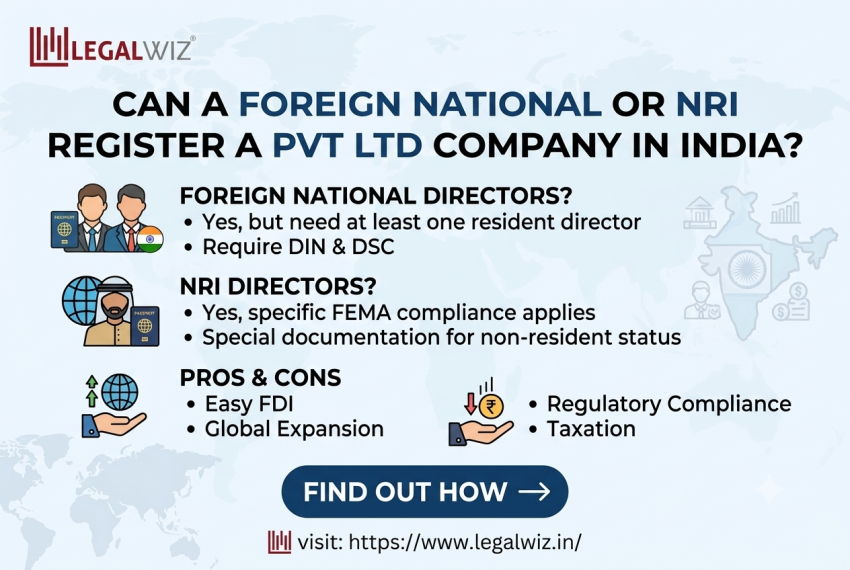
India has emerged as one of the world’s fastest-growing major economies, attracting global entrepreneurs, startups, and multinational corporations eager to tap into its massive consumer market and rich pool of technology talent. For international founders and Non-Resident Indians (NRIs), establishing a business footprint in India is no longer an intricate ordeal reserved only for conglomerates.
The short answer is yes—a foreign national, Overseas Citizen of India (OCI), or NRI can legally register a pvt ltd company in India. India’s liberalized Foreign Direct Investment (FDI) policy permits up to 100% foreign equity ownership in most sectors under the automatic route, meaning prior government or Reserve Bank of India (RBI) approval is not required for the majority of businesses.
Below is an in-depth breakdown of the legal framework, essential requirements, documentation, and step-by-step procedure for executing pvt limited company registration as a foreign national or NRI.
Legal Framework: Companies Act & FEMA Regulations
Company incorporation in India by foreign citizens or non-residents is primarily governed by two statutory pillars:
- The Companies Act, 2013: Regulated by the Ministry of Corporate Affairs (MCA), this framework sets out the rules for forming, running, and governing private limited entities in India.
- Foreign Exchange Management Act (FEMA) & FDI Rules: Administered by the Reserve Bank of India (RBI) and the Department for Promotion of Industry and Internal Trade (DPIIT), these guidelines govern foreign equity investments, share valuation, and inward remittances.
Together, these rules allow non-residents to hold 100% equity in an Indian entity, typically structured as a Wholly Owned Subsidiary (WOS) or a joint venture.
Core Eligibility & Structural Requirements
Before initiating the registration process, foreign founders must satisfy key structural conditions:
| Requirement | Statutory Mandate |
|---|---|
| Minimum Directors | Minimum of 2 directors. Foreign nationals and NRIs can serve as directors. |
| Resident Director Rule | At least 1 director must be a resident of India (stayed in India for at least 182 days in the preceding financial year). This director does not need to own shares or profits. |
| Minimum Shareholders | Minimum of 2 shareholders (can be foreign individuals, NRIs, or corporate entities). |
| Minimum Capital | No statutory minimum paid-up capital requirement under Indian law. |
| Registered Office | Must maintain a physical registered address within India for legal correspondence. |
Essential Documents Required for Non-Residents
Because foreign nationals and NRIs reside outside India, all identity and residential documents must undergo proper attestation.
For Foreign Individuals & NRIs:
- Passport: Mandatory primary identity proof for foreign nationals (must be valid). NRIs can also provide their Indian PAN card if available.
- Address Proof: Bank statement, utility bill, or driver’s license displaying the overseas address (issued within the last 12 months for foreign citizens).
- Passport-Size Photographs.
Attestation Rule: Documents originating outside India must be notarized in the home country, and apostilled (for Hague Convention countries) or legalized through the Indian Embassy/Consulate.
For Indian Registered Office:
- Proof of premise address (recent utility bill, electricity bill, or property tax receipt).
- No Objection Certificate (NOC) from the property owner along with a lease/rental agreement.
Step-by-Step Procedure to Register a Pvt Ltd Company
The Ministry of Corporate Affairs has digitized the incorporation process through an integrated online portal known as SPICe+ (Simplified Proforma for Incorporating a Company Electronically Plus).
Step 1: Obtain a Digital Signature Certificate (DSC)
Because incorporation is completely digital, all proposed foreign directors and shareholders must obtain a Class 3 Digital Signature Certificate. The DSC is used to electronically sign all official MCA forms.
Step 2: Reserve the Company Name
Founders can reserve a preferred business name using Part A of the SPICe+ form. The proposed name must be unique, aligned with the company’s business activities, and non-infringing on existing trademarks.
Step 3: Prepare MOA and AOA
The Memorandum of Association (MOA) outlines the main business objectives, while the Articles of Association (AOA) defines the internal management rules. For foreign-owned entities, these documents must explicitly reflect foreign equity holding structure.
Step 4: Submit the SPICe+ Integrated Form
Part B of SPICe+ merges several regulatory approvals into a single application:
- Allotment of Director Identification Number (DIN) for foreign directors.
- Company Incorporation Certificate.
- Permanent Account Number (PAN) and Tax Deduction Account Number (TAN) allotment.
- Mandatory registrations for EPFO, ESIC, and GSTIN (if applicable).
Step 5: Issuance of Certificate of Incorporation
Once the Registrar of Companies (ROC) reviews and verifies the application, it issues a Certificate of Incorporation (CoI) containing the unique Corporate Identity Number (CIN). The entity is now a distinct legal person under Indian law.
Crucial Post-Incorporation Compliances for Foreign Shareholders
Completing pvt limited company registration is only the first phase; foreign investors must adhere to mandatory financial and central bank regulations before commencing operations:
- Capital Remittance via Banking Channels: Share subscription money from foreign founders must be remitted into the Indian company’s corporate bank account via standard inward foreign currency remittance (NRE/FCNR account or foreign inward wire transfer).
- FC-GPR Reporting to RBI: Under FEMA regulations, the company must file Form FC-GPR (Foreign Currency Gross Provisional Return) on the RBI’s FIRMS portal within 30 days of issuing shares to foreign investors.
- Filing INC-20A (Commencement of Business): Within 180 days of incorporation, the company must file Form INC-20A with the Registrar of Companies, proving that subscribers have deposited their capital contribution.
Key Advantages of Incorporating a Pvt Ltd in India
- 100% Foreign Ownership: Complete control over shareholding and operational decision-making in permitted sectors.
- Limited Liability Protection: Shareholders’ financial risk is restricted solely to the unpaid value of their held shares.
- Ease of Global Expansion: A private limited entity can easily raise equity capital, grant ESOPs, and execute commercial contracts globally.
- Tax Benefits & DTAA: Foreign investors can leverage Double Taxation Avoidance Agreements (DTAA) signed between India and their native jurisdiction to prevent double taxation on dividends.
Conclusion
The Indian government has significantly simplified business setup procedures, allowing foreign founders and NRIs to register a pvt ltd company entirely online without needing a physical visit to India. By ensuring compliance with the Resident Director mandate, proper document apostillation, and timely post-incorporation RBI filings, international entrepreneurs can seamlessly establish their presence in India’s vibrant market.